
Have you ever wondered about the true amounts of snow around you? Most people instinctively look at depth, but two snowpacks of identical depth can differ enormously in weight, depending on how the snow formed, its age, and whether it has partially melted and refrozen. Height tells you what you can see. It does not tell you what you are dealing with. The number that actually does is Snow Water Equivalent, or SWE.
What Is SWE and How Does It Differ from Liquid Water Content?
Snow Water Equivalent is the total amount of water stored in a snowpack, solid and liquid combined. The simplest way to think about it: if all the snow on a surface melted at once, how deep would the resulting water be? SWE is expressed in millimetres or kilograms per square metre, which are equivalent units, and it is calculated by multiplying snow depth by snow density relative to water.
Liquid water content describes something different. Rather than the total water stored, LWC tells you how much of that water currently exists in liquid form within the snow, expressed as a percentage by volume or in kilograms per cubic metre. In a cold, dry snowpack, LWC is effectively zero, meaning all water is frozen. As temperatures rise and melting begins, liquid water starts filling the pore spaces between ice grains. The snow becomes heavier, bonds between grains weaken, and the structure begins to behave more like a saturated sponge than a solid.
The key difference between the two measures is this: SWE tells you how much water is stored in the snowpack in total, while LWC tells you the state of that snow right now, specifically how far into the melt process it is and how close it is to draining or running off. Understanding both together is particularly important during rain-on-snow events or rapid warming periods, when conditions can shift dramatically within hours.
How SWE Is Measured
Measuring SWE is not as straightforward as checking snow depth.
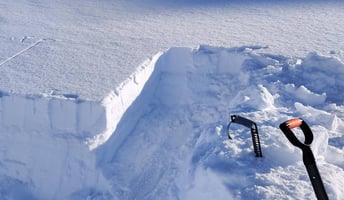
The most traditional method is a manual snow tube. A tube of known diameter is pushed through the full depth of the snowpack, and the extracted core is weighed. A simple calculation using the tube's cross-sectional area gives SWE in kg/m². It is low-tech and reliable in principle, but slow, labour-intensive, and difficult to perform across large or uneven surfaces.
Snow weight scales offer a more continuous approach. A pressure sensor buried at ground level measures the load of the snowpack above it directly. These are accurate and require no manual intervention, though installation costs and the practical challenge of placing them in the right locations have limited their widespread use. A related approach is the snow scale, a surface-mounted device that directly measures the weight of snow accumulating above it and can report SWE continuously without requiring burial during installation.
Satellite imagery has opened up large-scale SWE estimation. By comparing microwave backscatter signals or passive microwave emissions, satellites can estimate snow water equivalent over wide areas. The spatial coverage is unmatched, but accuracy in complex terrain or during rain-on-snow events remains an ongoing challenge.
Drone-based surveys are increasingly used, especially where access is difficult. Combined with photogrammetry and ground reference points, drones can map snow depth accurately across large areas. Converting depth to SWE still requires density information, which is where complementary sensors or models come in.
Modelling fills in the gaps where direct measurement is not available. Snow models driven by meteorological inputs such as temperature, precipitation, wind, and radiation simulate the evolution of the snowpack over time, including SWE. These models are most reliable when anchored with measured observations at the local level.
What most of these methods have in common is that they rely heavily on manual effort. Snow tube surveys require trained personnel to go out into the field, often in difficult conditions, and repeat the process at regular intervals. Even well-run programmes typically produce measurements only a few times per season. That introduces two problems: the data is a snapshot rather than a continuous record, and it is only as consistent as the people collecting it. Technique variation, equipment handling, and the simple reality that conditions change between visits all introduce uncertainty. For decisions that hinge on whether SWE is rising, stable, or starting to melt, a measurement from three days ago may already be telling the wrong story.
What Continuous Monitoring Adds
This points to a broader challenge in SWE monitoring: getting accurate, timely data in the right place. A single manual measurement tells you what the snowpack looked like at one moment. What actually drives better decisions is understanding how conditions are changing, and that requires continuous, localised monitoring.
A well-placed IoT weather station provides exactly that. Combined temperature, humidity, and wind data support real-time SWE estimation and reveal where drifting is concentrating load unevenly. The result is a picture that no periodic manual survey can match.
SWE Beyond the Snowpack
SWE is not simply a measure of how much snow is sitting on the ground. It represents stored water that will eventually move somewhere: into rivers, into the ground, into reservoirs, or into the atmosphere. Understanding where it goes, and when, is fundamental to managing water resources across entire regions.
In terms of runoff prediction, SWE tells hydrologists how much water is currently locked up in a drainage basin's snowpack. When that snow melts, some of it flows into rivers, streams, and lakes. Some infiltrates into the soil and recharges groundwater reserves. Some evaporates back into the atmosphere. The balance between these pathways depends on melt rate, soil conditions, and land cover, but it all starts with knowing the total water available, which is what SWE provides.
For flood forecasting, a high-SWE snowpack combined with a rapid warming event or heavy rain is one of the most reliable precursors to significant flooding. Knowing the stored water volume in advance allows authorities to issue earlier warnings, manage reservoir levels proactively, and prepare emergency response before conditions become critical.
In water-scarce regions, seasonal snowpack is not a hazard but a lifeline. Large parts of the world depend on snowmelt as their primary source of drinking water and irrigation. Accurate SWE measurement directly translates into better planning for dry seasons, earlier identification of drought conditions, and more sustainable allocation of water between competing demands.
Who Benefits and Why It Matters
SWE is not an obscure technical metric. Several industries and fields depend on it directly.
Hydropower operators need to know how much water is stored in the seasonal snowpack across their catchment areas. Spring snowmelt is a major driver of reservoir inflows, and accurate SWE data allows operators to plan storage, generation, and water release well in advance. An unexpected rapid melt event can be managed proactively rather than reactively, but only if the stored water equivalent is known beforehand.
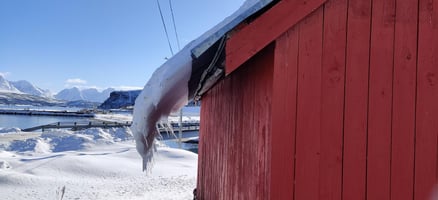
Roof maintenance companies and property owners face a more immediate challenge. When snow accumulates on rooftops, what matters structurally is not how deep the snow is but how heavy it is. Wet or refrozen snow can be several times heavier per unit depth than fresh powder, and without knowing the actual load, decisions about when to clear a roof are based on appearance rather than reality, which means they are often either too early or too late.
Avalanche forecasters also use SWE as part of their assessment. Snowpack layering is central to avalanche risk, and weak layers buried beneath stronger slabs are what make slopes unstable. A heavy, high-density snowfall adds significantly more weight than the same depth of light powder, and that difference in loading can be what tips a slope from stable to critical. Tracking SWE through new snowfall events gives forecasters a clearer picture of whether buried weaknesses are being pushed toward failure.
Päätelmä
Snow Water Equivalent is where winter weather becomes a structural and hydrological reality. Snow depth tells you what you can see. SWE tells you what you are actually dealing with. Whether you are managing a reservoir catchment, maintaining a building portfolio, assessing flood risk, or evaluating avalanche conditions, SWE is the number that determines what action is needed and when. Measuring it continuously, in context, and in the right locations is what separates informed decisions from guesswork.
Follow for more!