
A Simple Guide to Snow Metamorphism
When most of us look at snow, we see a white surface. Maybe it’s soft powder. Maybe it’s wind-blown and crusty. But what we’re standing on is not just “snow.” It’s a layered, constantly changing structure. Beneath that smooth surface lies a stack of crystals, bonds, hard slabs, and layers of different hardness. These layers evolve over time depending on weather and temperature conditions.
This constant change is called snow metamorphism, and it determines what the snowpack looks and feels like. These layers influence not only avalanche conditions, but also whether reindeer can graze through the snow, how easily we can move on skis, and how much effort it takes to shovel the driveway.
Snow on the ground is more than frozen rain. It is a porous mass of ice crystals filled with air, water vapor, and sometimes liquid water. Even though snow feels cold, it is actually “warm” in a physical sense. It exists very close to its melting point compared to most natural materials. That means small changes in temperature, sunlight, wind, or added weight can reshape it. Snow is unstable by nature — it is always evolving.
How Snow Layers Form
Each snowfall or wind event creates a new layer. Temperature, wind, and humidity determine what kind of snow falls and how it settles. Some storms bring large, delicate, cartoon-like flakes. Others bring smaller, denser grains. Wind can pack snow grains into hard slabs. Over time, the snowpack becomes layered like a cake, with each layer having different grain shapes, sizes, densities, and strengths.
Types of Snow Metamorphism
Fresh snowflakes do not stay beautiful for long. Once they reach the ground, their branches break, grains shrink or grow, and crystals begin bonding with one another. This transformation is driven by the snowpack’s energy balance, which creates temperature differences, vapor movement, and pressure changes within the snow.
When temperature differences inside the snowpack are small, grains slowly round out and bond together. This process, called rounding or isothermal metamorphism, strengthens the snow.
When the temperature gradient in the snow is large, such as when the ground is relatively warm and the air above is very cold, water vapor moves through the snowpack, growing the crystals and creating sharp, angular forms called facets. These faceted crystals do not bond well and can form persistent weak layers. This process is also known as kinetic metamorphism.
The third form of metamorphism is melt–freeze metamorphism. In this process, the snow warms to 0 °C and the crystals begin to melt at their edges. They round off and bond more tightly at first, which can temporarily increase strength and make the snow more compact. However, as more meltwater fills the pores and separates the grains, the bonds disappear and the snow rapidly loses strength until refreezing forms a hard crust or, with repeated cycles, granular corn snow.
Mechanical Effects and Surface Phenomena
Pressure also changes snow. Skiers, wind, and additional snowfall compact grains and push them closer together. As grains press against each other, they bond through a process called sintering. That is why snow on a ski run hardens over time. It is not just compressed but bonding at a microscopic level.
One of the most visible surface processes is surface hoar, delicate frost crystals that form on clear, calm nights as the snow surface cools rapidly. These crystals can grow surprisingly large and fragile, and if they are buried by new snowfall, they often become weak layers that may remain unstable for weeks.
Understanding the Snowpack
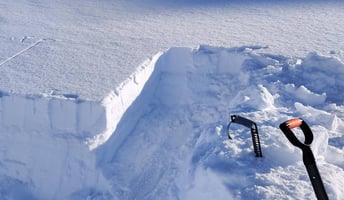
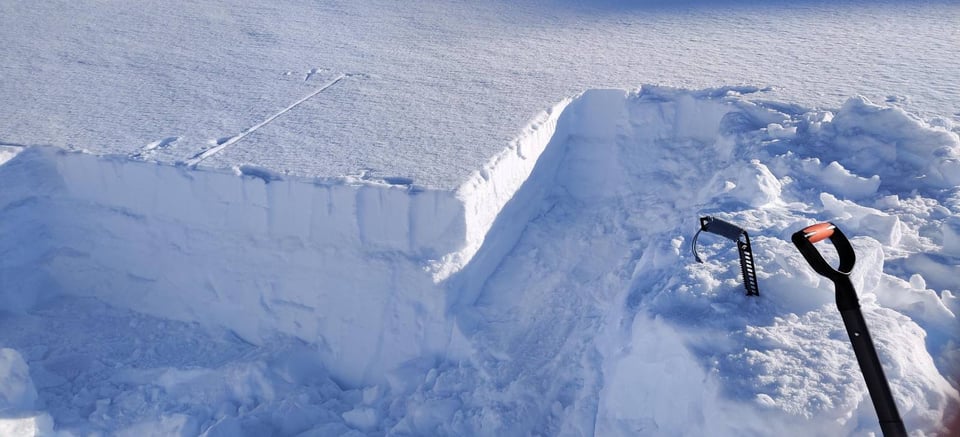
Snow professionals study the snowpack by digging pits and examining grain types, hardness, temperature, and bonding between layers. Each layer tells the story of past weather events: windstorms, cold snaps, warm periods, and clear nights. Just as important as the layers themselves are the interfaces between them, the boundaries where two different layers meet. These interfaces often represent abrupt changes in hardness, density, or crystal structure. Instrumentation, such as weather stations are also an important factor to help gain deeper knowledge.
All of this matters because avalanches frequently occur at these layer interfaces. A strong slab resting on top of a weak layer creates a structural imbalance. From above, a slope may look smooth and stable, but weakness can hide along the boundary between layers beneath the surface.
Snow is not static. It settles, bonds, fractures, melts, refreezes, and reshapes itself constantly. The surface is only the beginning. What lies beneath, and especially how layers connect or fail at their interfaces, determines the overall structure and stability of the snowpack.
Next time you are out on the snow, try digging or probing into it. You may be surprised at how many layers you find and how different they feel from one another.
Follow for more!