
Snow drift is the movement and redistribution of snow by wind. While snowfall determines how much snow reaches the ground, wind largely controls where that snow accumulates. In exposed environments such as mountain ridges, open terrain, roads, and cities, wind erodes snow from some locations and deposits it in others, often over short distances. As a result, snow depth, density, and stability can vary dramatically across the landscape. Winds can deposit snow three to five times faster than snow accumulation from the sky.
Understanding snow drift is essential for avalanche safety, transportation, and winter planning in both natural and urban environments. Wind does not simply move snow; it also transforms it.
When and Why Snow Drifts
Snow begins to drift when wind forces at the surface of the snow exceed the forces holding snow grains in place. This threshold depends strongly on snow properties. Fresh, dry snow with weak bonding can be mobilized at relatively low wind speeds, while dense or moist snow requires stronger winds.
Typical threshold wind speeds for initiating snow transport near the surface are on the order of 3 to 8 meters per second. Higher wind speeds, roughly 7 to 15 meters per second, are needed to lift particles into sustained suspension. Gusts are particularly effective because brief spikes in wind speed can initiate snow transport even when mean winds are relatively weak.
The Physics of Snow Drift
Once snow grains are set in motion, wind transports them through a combination of processes and simultaneously alters their physical properties.
Snow moves by creep, saltation, and suspension. In creep, grains roll or slide along the surface after being impacted by moving particles. Saltation involves grains that are briefly lifted and follow hopping trajectories close to the surface and typically accounts for most of the transported mass at moderate wind speeds. Suspension occurs when fine particles are lifted by turbulence and carried higher into the atmosphere, allowing transport over long distances.
The relative importance of these transport modes depends on wind speed and turbulence. At lower wind speeds, saltation dominates, while at higher wind speeds suspension becomes increasingly important. Transport does not increase indefinitely with wind speed. As the air near the surface becomes loaded with snow particles, further erosion becomes less efficient, leading to saturation of transport.
During snowfall, wind often redistributes snow primarily through preferential deposition rather than erosion. Snowfall interacting with turbulent flow is deposited unevenly, with sheltered areas accumulating significantly more snow even when surface drifting is limited.
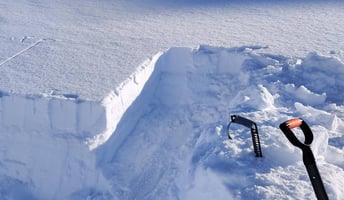
Wind also rapidly changes snow structure. Grain collisions cause fragmentation and rounding of the snow grains, packing increases density, and bonding between grains strengthens. These processes lead to the formation of hard wind slabs, often within hours, and create sharp contrasts in snowpack structure over short distances.
Snow Drift in Natural Terrain
In mountainous terrain, snow drift produces highly variable snow distributions. Wind erodes snow from windward slopes and ridges and deposits it on leeward slopes, in bowls, gullies, and other terrain traps. As a result, the deepest and densest snow often forms where the wind slows or separates from the surface.
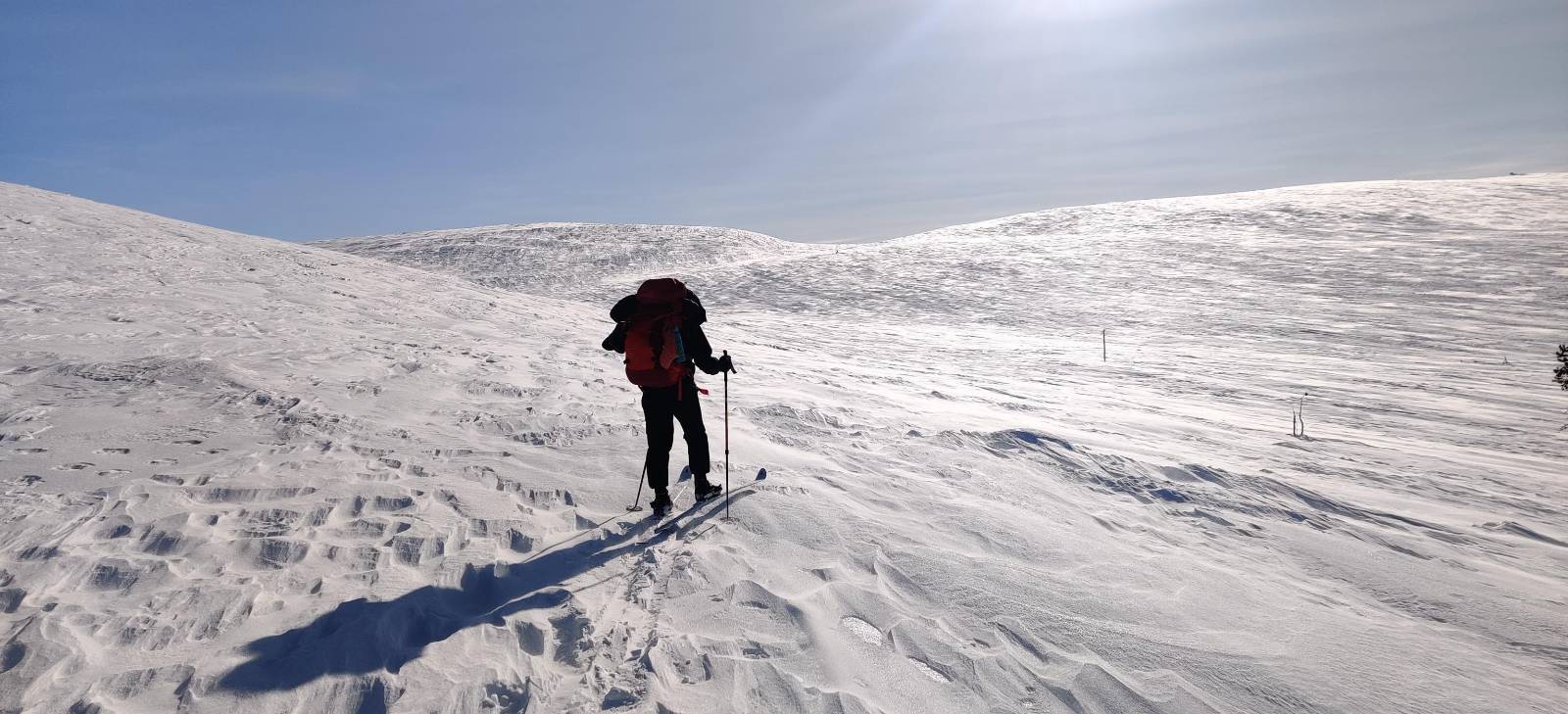
Wind effects are frequently visible. Sastrugi form as ridged, sculpted surfaces where snow has been eroded. Ridge crests may appear scoured, while wind lips and cornices develop at breaks in slope. Snow depth can change abruptly within just a few meters.
From an avalanche perspective, drifting snow is one of the most important loading mechanisms. Wind slabs commonly form on leeward slopes and may overlie weaker layers. These slabs can appear smooth and stable yet remain highly sensitive to triggering. Recognizing wind features is therefore a core component of avalanche assessment, as emphasized by organizations such as the American Avalanche Association.
Snow Drift in Urban and Road Environments
Snow drift also plays a major role in built environments. In cities and along roads and railways, buildings and other infrastructure that affect the airflow and create zones of enhanced erosion and deposition.
Wind corridors commonly form along streets, between buildings, and across open areas. Snow tends to accumulate along roadsides, behind embankments, and in cuttings, particularly in open or elevated terrain. Topography is also a significant parameter that needs to be considered with snowdrift in the roads.
Blowing snow can significantly reduce visibility even without active snowfall, hence increasing the risks for drivers or pedestrians. Vehicles also influence snow drifting and visibility on the road. Airflow around moving cars generates turbulence that impacts where snow preferentially deposits. This turbulence can also work as a force that keeps the roads clean from snow.
Mitigation and Prevention
Because snow drift is driven by wind–snow interactions, mitigation focuses on controlling airflow and managing where snow is deposited rather than attempting to stop transport entirely.
Common measures include snow fences and deflectors that force snow to accumulate in designated areas, strategic placement of barriers upwind of roads or infrastructure, and urban design that avoids strong wind acceleration between buildings. In natural terrain, mitigation options are limited, making observation and understanding of drift patterns especially important. Nowadays, some instruments measure both the snow and wind parameters. That data can be very valuable for road authorities to see if the road needs clearance. This data also helps different models that can help with decision-making.
Conclusion
Snow drift is one of the dominant processes shaping winter snow cover. Wind determines where snow accumulates, how dense it becomes, and how hazardous it is. From sculpted ridgelines in alpine terrain to snow-filled roads in cities, drifting snow creates patterns that are both visually striking and operationally critical.
Recognizing the signs of snow drift and understanding the processes behind them is essential for safety, forecasting, and winter design. Snowfall provides the raw material, but wind ultimately defines the outcome.
Follows us for more!