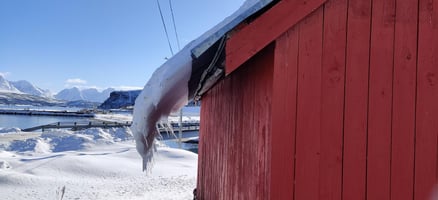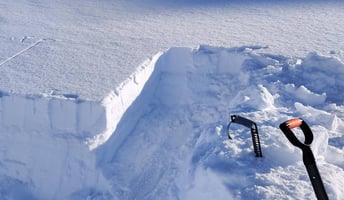

Snow drift is the movement and redistribution of snow by wind. While snowfall determines how much...

When temperatures hover around the freezing point, one of the most challenging winter hazards can form on road surfaces: black ice. This thin, transparent glaze of ice blends into the pavement because it contains no air bubbles and allows the underlying asphalt to remain visible. Its near invisibility makes it especially dangerous for both drivers and pedestrians.
Why Black Ice Is a High-Risk Phenomenon
Black ice significantly increases the likelihood of traffic incidents during the cold season. The primary danger is the sudden, unexpected loss of traction. Because its visual signature is minimal, people often detect it only when slipping or skidding.
It forms most frequently in microclimates where surface cooling is intensified or moisture availability is higher, such as:
- Bridges and overpasses, which cool rapidly due to air exposure on all sides
- Concrete surfaces, which have high thermal conductivity
- Shaded areas, where incoming solar radiation is limited
- Low-lying terrain, where cold air pools
- Areas near water bodies, which have higher humidity
- Lightly trafficked roads, which lack frictional warming from vehicles
Mechanisms of Black Ice Formation
Research identifies three primary mechanisms behind black ice formation, each driven by different surface-energy and atmospheric conditions.
1. Hoar Frost FormationHoar frost–based black ice forms under clear skies, low wind, and strong nighttime radiative cooling. It occurs when:
- The road surface temperature drops below 0 °C, and
- The dew point temperature is close to, and typically slightly above, the road surface temperature, indicating a moist near-surface layer on the road.
Under these conditions, water vapour deposits directly onto the cold surface as ice crystals. Because this frost layer is thin and transparent—especially on dark asphalt—it can mimic the appearance of a wet road.
2. Precipitation-Induced Black Ice
Black ice also forms when precipitation freezes on contact with a subfreezing road surface. Several precipitation types contribute:
- Freezing rain, where liquid droplets freeze instantly on the surface
- Sleet/ice pellets, which may refreeze onto roadways
- Wet snow or light rain, which can melt slightly and refreeze on cold pavement
The precipitation type depends on vertical temperature profiles, particularly warm layers above a subfreezing surface layer.
3. Melt–Freeze (Snowmelt) Scenario
This common mechanism occurs when daytime warming produces liquid water—such as melted snow or slush—followed by a rapid temperature drop at night. When:
- The road surface temperature falls below 0 °C, and
- The near-surface air remains relatively moist, resulting in a small difference between road temperature and dew point,
The remaining water refreezes into a thin, transparent glaze. This frequently occurs at sunset during clear, calm conditions.
Detecting and Modeling Black Ice
Because black ice is visually subtle, instrumentation and numerical modelling are essential for detection and forecasting.
Models typically incorporate these variables:
- Ta — ambient air temperature
- Ts — road surface temperature
- Td — dew point temperature
- Wind speed — influences boundary-layer mixing and radiative cooling
- Cloud cover and radiation — control nighttime cooling rates
- Tw (wet-bulb temperature) — particularly important for diagnosing freezing rain and mixed-phase precipitation
Data Sources and Predictive Systems
To anticipate black ice, weather services and road authorities rely on a combination of atmospheric data and surface-based observations. These systems typically integrate:
- Vertical temperature profiles, which show how temperatures change with height and help identify freezing layers in the atmosphere.
- Numerical weather model outputs, providing forecasts of temperature, humidity, and precipitation type
- Road-weather models that simulate road surface temperature, moisture, and freezing risk based on weather inputs and surface characteristics.
Together, these data sources support early warnings, road treatment decisions, and real-time hazard monitoring. Additionally, they provide information to support winter maintenance decisions, such as salting, sanding, and other preventive measures.
Local road sensors—such as infrared surface thermometers and moisture detectors provided by various commercial systems—can be integrated by road authorities or municipalities to improve point-level detection. Snower provides solutions to gather point-level data and also provides local modelling based on measured parameters as surface-based observations.
Practical Safety Considerations
Scientific understanding is essential, but behavior matters too. To reduce risk:
- Reduce speed when temperatures are near freezing
- Avoid sudden braking or sharp steering
- Monitor road-weather forecasts and local road cameras
- Use winter tyres, which substantially increase friction on icy surfaces
Conclusion
Black ice is a thin, nearly invisible layer of ice formed through subtle interactions between surface temperatures, humidity, radiation, and precipitation. Understanding the physical processes behind hoar frost, freezing precipitation, and melt–freeze cycles—and leveraging modern detection systems—enables more accurate prediction and safer roads.
Follow us for more!❄️